
Most social selling advice is written for someone sitting at a desk with a full day to scroll LinkedIn. That’s not you.
You’re managing a territory. You’ve got eight stops planned and a prospect who just rescheduled. The idea of building a “personal brand” sounds like something people do when they don’t have a quota to hit. And yet — the rep in the next territory who spends 15 minutes on LinkedIn before her first meeting closes more deals and gets fewer cold shoulders at the door. Social selling works. It just has to be built around how field sales actually runs.
This playbook covers what B2B social selling looks like when you’re on the road five days a week: how to research prospects before a visit, what to post when you have five minutes between stops, how to follow up after a face-to-face meeting, and how to measure whether any of it is moving your numbers.
What Is B2B Social Selling?
Social selling is the practice of using social media — primarily LinkedIn — to research prospects, build credibility, and warm up relationships before and after in-person interactions. It’s not posting corporate updates. It’s not collecting connections. And it’s definitely not sending a pitch in someone’s DM the moment they accept your request.
For field sales reps, social selling is the digital layer that runs alongside your in-person work. You knock on doors or walk into accounts — social selling makes sure the person on the other side already has a reason to respect you before you shake hands.
Social Selling vs. Cold Outreach
The data on this is stark. According to LinkedIn’s own research, reps who use social selling create 45% more pipeline opportunities than those who don’t. They’re 51% more likely to hit quota. And 78% of social sellers outperform peers who rely solely on cold outreach.
Cold calls and cold emails aren’t dead — but they’re fighting an uphill battle. Industry research shows it takes an average of eight call attempts to reach a single B2B decision-maker, and cold outreach response rates have fallen sharply — most decision-makers now ignore unsolicited calls and emails entirely. Social selling doesn’t replace your field activity. It makes every touchpoint warmer before it happens.
Why It Matters More for Field Reps
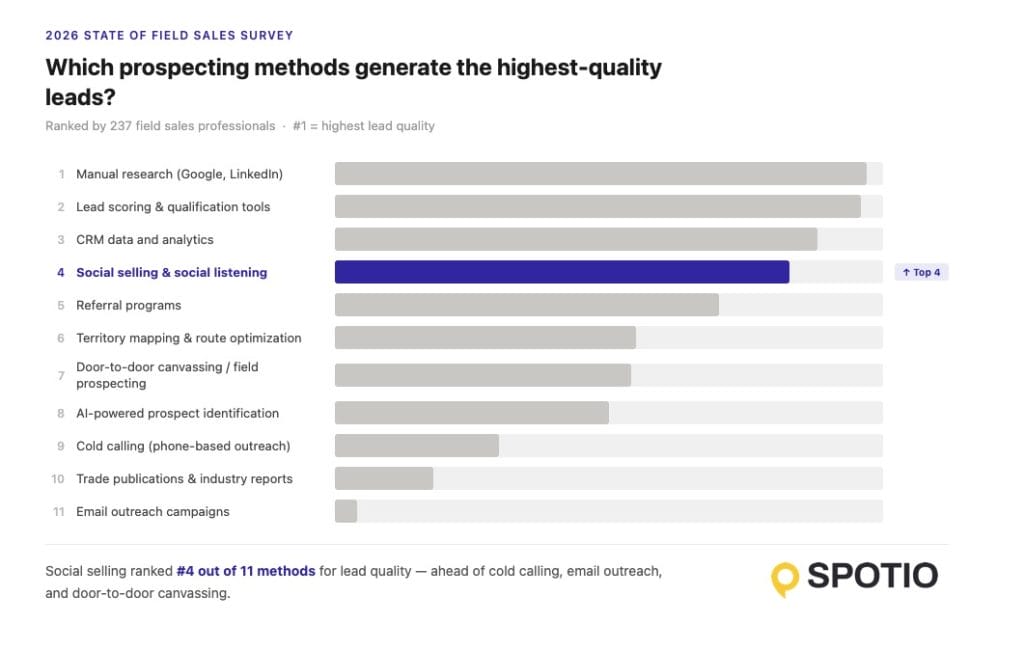
Inside sales reps can run 50 outbound touches a day. You can’t. What you can do is make every door you knock matter more. Field sales professionals back this up: in SPOTIO’s 2026 State of Field Sales survey, social selling and social listening ranked #4 out of 11 prospecting methods for lead quality — ahead of cold calling, email outreach campaigns, and door-to-door canvassing.
When a prospect recognizes your name, has seen a useful post you shared, or noticed you commented on something their VP said — your opening five seconds go from stranger to someone they’ve already seen. That’s the field sales case for social selling.
Build a LinkedIn Profile Worth Finding
Before you try to reach anyone on LinkedIn, ask yourself: if a prospect looked you up right now, what would they find?
A half-filled profile with no photo, a generic headline, and zero activity is an active liability. Decision-makers check you out before they reply to your emails, before they open the door, and often before they agree to keep a meeting on the books. Your LinkedIn profile is your pre-call credibility — treat it like your suit.
The Five Elements That Actually Matter
- Headline: Lead with the value you bring, not your job title. “Helping regional distributors reduce rep onboarding time in competitive markets” says more than “Territory Sales Rep at [Company].”
- About section: Write in first person. One paragraph on what you do, one on who you help, one on what success looks like for your customers. Keep it under 200 words.
- Featured section: Pin a relevant case study, a short post about a challenge you solved, or a customer result in plain numbers. This is the first thing visitors see on your profile.
- Activity: LinkedIn’s algorithm surfaces profiles that post and engage. A dormant profile ranks lower in searches and looks abandoned to prospects who check you out.
- Recommendations: Two or three genuine recommendations from customers or managers do more for credibility than anything you write about yourself.
Your SSI Score: The One Metric Worth Tracking
LinkedIn’s Social Selling Index (SSI) is a free score from 0–100 that measures how effectively you’re using the platform across four dimensions: professional brand, finding the right people, engaging with insights, and building relationships. Check yours at linkedin.com/sales/ssi.
A score above 70 puts you in the top tier. LinkedIn’s research shows reps with high SSI scores generate 45% more opportunities than those with low scores. More practically: SSI is the one leading indicator you can actually see moving week over week as you build your social selling habits.
Research Prospects Before Every Visit
This is where social selling pays off fastest for field reps — and where most reps skip a step that takes under ten minutes.
Before a meeting, pull up your prospect’s LinkedIn profile. You’re not looking for personal details to manufacture rapport. You’re looking for:
- Recent posts or activity — Did they comment on something about supply chain issues, regulatory changes, or a new product launch? That’s your opening.
- Job changes — A new VP of Sales or a recently promoted decision-maker is in evaluation mode and more likely to consider new vendors.
- Shared connections — A mutual connection is worth a sentence in your outreach or a natural reference in conversation.
- Company news — New funding, a leadership change, or a new initiative? Prospects notice when you show up informed.
Using Sales Navigator for Territory-Level Prospecting
If you’re covering a defined territory, LinkedIn Sales Navigator earns its cost quickly. You can filter prospects by geography, job title, seniority level, and company size — then save those accounts for ongoing monitoring. When a saved prospect changes jobs or posts about a pain point, you get an alert. For a rep managing 50+ accounts across a territory, that kind of passive intelligence is hard to replicate any other way.
Pair Sales Navigator with SPOTIO’s territory management and you have a complete picture: who’s in your territory on the map and what they’re saying on LinkedIn before you knock.
Engage Prospects Without Pitching
The most common mistake field reps make on LinkedIn: treating it like a cold call channel. The moment you connect with someone and send a “just wanted to introduce myself and see if you’d be open to a quick call” message, you’ve turned a warm channel cold.
Engagement before outreach is the operating principle. Spend two weeks liking, commenting on, and occasionally sharing content from your target accounts before you send a single direct message. A thoughtful comment on a prospect’s post — something that adds a point of view, not just “Great insight!” — puts your name and face in their peripheral vision. By the time you reach out, you’re not a stranger.
When you do send a direct message, reference something specific: a post they shared, a company announcement, or a challenge their industry is visibly dealing with. Keep it short. No pitch. One sentence on why you’re reaching out, one on why it’s relevant to them, one question or soft ask. That’s it.
Three Habits That Kill Your Social Selling Credibility in 2026
AI-generated outreach has flooded LinkedIn. Buyers are better at spotting it than ever — and for field reps whose entire value is personal relationship-building, getting flagged as a bot is a hard hole to climb out of. Avoid these:
- Automating connection requests. AI-drafted “I came across your profile and thought we should connect” messages are everywhere. They read like what they are. Write your own, even if it takes 30 extra seconds.
- Resharing only company content. If every post on your profile is a corporate announcement or a marketing graphic, you have no social selling presence — you have a company newsletter with your face on it. Your activity needs your voice, not your employer’s brand team’s.
- Connecting without engaging. Sending 100 connection requests and then going silent doesn’t build a warm audience — it builds a list of people who forgot who you are. Engage with someone’s content before you connect, and continue after. Otherwise you’re just collecting contacts, not building relationships.
Nurture Relationships Between In-Person Visits
Field sales runs on relationship density — how many meaningful touchpoints you have with an account between visits. Social selling fills that gap.
After a face-to-face meeting, send a personalized LinkedIn connection request (or follow-up message if already connected) within 24 hours. Reference something specific from the conversation. Don’t attach a proposal. Don’t recap your product. Just continue the conversation.
What to Do Between Stops
You have more windows than you think — waiting in a lobby, a few minutes before your next appointment, between back-to-back calls. Use them to:
- Congratulate a contact on a promotion, award, or company milestone
- Share a short post about something you observed in the field that day — a trend, a customer question, a problem you helped solve
- Comment on content from two or three target accounts
- Check Sales Navigator alerts for activity from saved prospects
None of these takes more than five minutes. Done consistently, they keep you present in your prospects’ feeds without requiring a desk.
The Post-Meeting Follow-Up That Actually Works
Most follow-up emails get buried. A LinkedIn message after a face-to-face visit has a different feel — it signals you took the time to connect personally, not just add someone to a sequence.
A good post-visit LinkedIn follow-up is three sentences: what you appreciated about the conversation, one specific thing you’re following up on or sending over, and a low-pressure next step. Log the interaction in your CRM immediately — that touchpoint belongs in the activity record alongside your visit notes.
Build a Content Habit That Fits the Field
You don’t need to become a LinkedIn influencer. You need to post consistently enough that your name shows up in your prospects’ feeds on a semi-regular basis. For most field reps, one to two posts per week is a realistic starting point — consistent enough to stay visible without turning LinkedIn into a second job.
What Field Reps Should Actually Post
The best performing content for field sales reps isn’t polished thought leadership. It’s specific, grounded, and short:
- A question you keep hearing from customers and how you think about it
- An observation from a territory visit (“Walked into three accounts this week where the same challenge came up…”)
- A result a customer achieved, described in plain terms
- A quick take on an industry development that affects your prospects
Stay away from sharing your company’s marketing posts as your primary content. That’s not social selling — that’s a company newsletter. Your posts should sound like you, not like your employer’s brand team.
Balancing Your Brand with the Company’s
Your personal credibility and your employer’s brand aren’t in competition — but they are distinct. Prospects connect with people, not logos. When you amplify company content, add your own sentence or two before you share it. “We just published this. The part about territory efficiency resonated with what I’m seeing on the ground” is worth ten times more than a bare reshare.
Connect Social Selling to Your Field Sales Workflow
Social selling doesn’t operate in a separate silo from the rest of your sales process — it should feed directly into how you prioritize accounts, prepare for visits, and log activity.
The reps who get the most out of social selling are the ones who treat LinkedIn signals the same way they treat CRM data: as input for decisions. A prospect who just posted about a budget freeze gets deprioritized this quarter. A contact who commented on a competitor’s content gets moved up the call list. A decision-maker who accepted your connection request and viewed your profile twice this week might be ready for a visit.
Want to see how field teams track every prospect touch — digital and in-person — in one place? Explore SPOTIO’s activity tracking for field sales →
Logging Social Touchpoints in Your CRM
Every meaningful social interaction — a DM exchange, a post comment that got a reply, a connection accepted before a scheduled visit — belongs in your activity log. Not because compliance demands it, but because the rep who picks up this account in 18 months (or the manager reviewing pipeline) needs the full picture of how a relationship developed.
In SPOTIO, reps log these touchpoints with one tap alongside in-field visits, calls, and emails — giving you and your manager a complete view of relationship depth per account, not just visit frequency. When you’ve logged four social touches, two visits, and a demo in the last 60 days, you and your manager know exactly where you stand with that account — no guessing, no gaps.
Measuring Social Selling Results
Most reps who abandon social selling do it because they can’t see it working. Here’s what to actually track.
Leading Indicators (Weekly)
| Metric | What to Track | Why It Matters |
|---|---|---|
| SSI Score | Check weekly at linkedin.com/sales/ssi | Rising score confirms your habits are building |
| Connection acceptance rate | % of requests accepted within 7 days | Signal of profile strength and targeting accuracy |
| Post engagement rate | Likes + comments per post | Low engagement = content not resonating with your audience |
| Response rate on DMs | % of messages that get a reply | Measures outreach quality and warm-up effectiveness |
Lagging Indicators (Monthly)
| Metric | What to Track |
|---|---|
| Meetings booked from social touchpoints | Tag the source in your CRM when scheduling |
| Opportunities influenced by social activity | Accounts with 2+ social touches before opportunity creation |
| Pipeline from social-sourced leads | Track separately from cold outreach for clean comparison |
Give it 90 days before drawing conclusions. Social selling is a compounding activity — the first month feels slow, the third month starts converting. Reps who quit after four weeks never see the payoff. For a deeper look at what your sales managers should be monitoring across the team, this field sales monitoring guide covers the full picture.
Frequently Asked Questions
B2B social selling is the practice of using social media platforms — primarily LinkedIn — to research prospects, build credibility, and warm up relationships before and after sales interactions. It replaces cold outreach with relevance: instead of interrupting buyers, you earn their attention by showing up in their feeds with useful content and genuine engagement. According to LinkedIn’s research, social sellers create 45% more opportunities and are 51% more likely to hit quota than peers who don’t use social media.
Social media marketing is a one-to-many broadcast function — your company’s marketing team publishing content for brand awareness at scale. Social selling is individual reps building real relationships with specific prospects. Both matter, but they serve different purposes. A rep doing social selling is having targeted one-on-one conversations, not running campaigns.
Start with your profile: complete headline, strong About section, recent photo. Then spend two weeks engaging — comment on posts from prospects and industry voices in your territory. Don’t send a single pitch. After two weeks, you’ll start feeling less invisible — and prospects will start recognizing your name before you reach out. Only then start direct outreach.
LinkedIn considers a score above 70 high-performing. The average sales professional scores in the 40–50 range. For field sales reps, aim for 60+ within the first 90 days of consistent effort, with a target of 70+ once the habit is established. Check yours free at linkedin.com/sales/ssi — it updates daily and breaks down your score across four pillars.
Done efficiently, 15–20 minutes a day covers most of it: 5 minutes of profile monitoring and Sales Navigator alerts, 5–10 minutes of post engagement, and 5 minutes responding to messages or comments. Posting once or twice a week adds another 10–15 minutes. It’s not a second job — it’s a habit that stacks on top of the prep work you’re already doing.
Connect before — but engage before you connect. Spend a few days commenting on their content or content they’d care about. Then send a connection request with a brief, personalized note. When you call or visit, they’ve seen your name. The conversation starts warmer than it would have cold.
Tag meeting sources in your CRM and track which opportunities had social touches before the first in-person interaction. Look for a correlation between accounts with multiple social touchpoints and shorter sales cycles or higher close rates. After 90 days, compare pipeline from accounts you’ve engaged socially versus those you haven’t. That’s your proof.
The Field Rep’s Advantage
Social selling isn’t a replacement for knocking doors and building face-to-face relationships — it’s what makes those interactions land harder. The reps closing more deals aren’t doing more activity. They’re doing smarter prep, staying present between visits, and making sure that by the time they’re standing in front of a buyer, the relationship has already started.
Start with your profile. Pick two prospects in your territory to engage this week. Post one honest observation from the field. See what happens in 90 days.
SPOTIO helps field teams log every touchpoint — digital or in-person — against their territory and pipeline, so managers and reps always have a clear picture of where each account stands. See how SPOTIO supports field sales teams →